In God Is Not Great, Christopher Hitchens is particularly scathing about the strong link between religion and tyranny. Like many of the writers I’m attracted to, rather than defining him along the left/right political spectrum, it’s easier to see him as fundamentally concerned with arguing against tyranny. And god, for Hitchens, is the ultimate tyrant. Regardless of whether your god is benevolent or malevolent he is a tyrant. He is the ultimate totalitarian as he lays claim to “the contents of your heart and your head” (God Is Not Great 231).
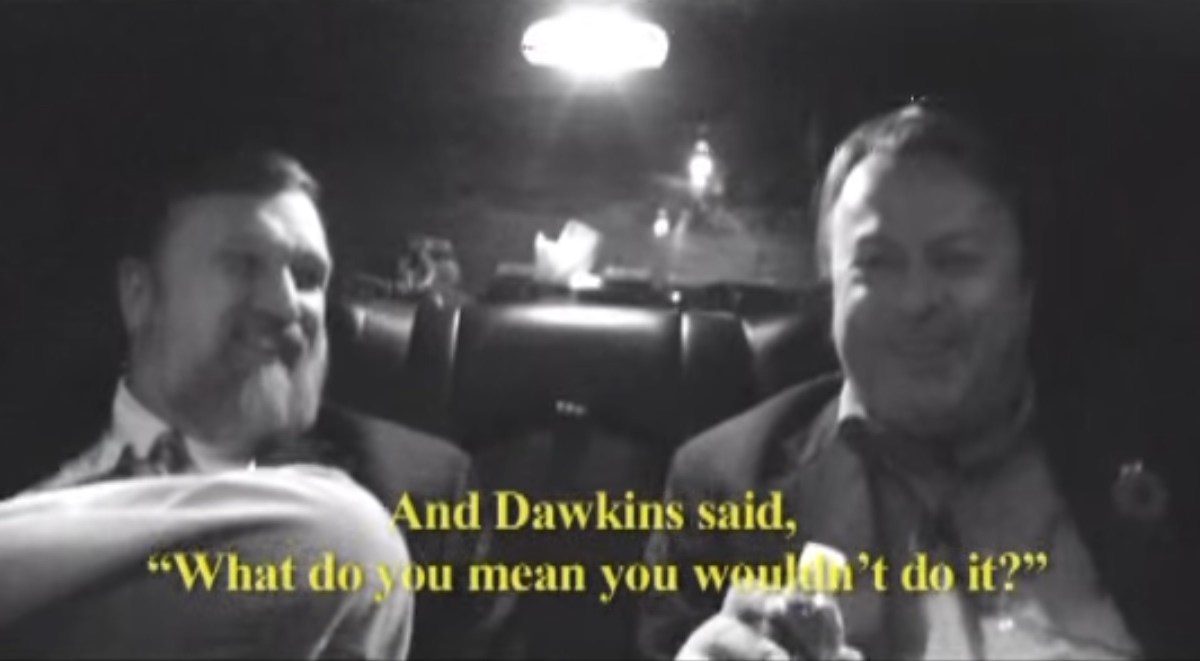
It was therefore surprised me to see a clip in which Hitchens conceded that he would preserve a tiny corner of religion, even if he had the power to eradicate it completely. Here’s a transcript of the clip, which comes for a documentary – Collision – that he made with the theologian Douglas Wilson:
I said if I could convert everyone in the world, not convert, if I could convince to be a non-believer and I’d really done brilliantly, and there’s only one left. One more, and then it’d be done. There’d be no more religion in the world. No more deism, theism.
I wouldn’t do it.
And Dawkins said, “What do you mean you wouldn’t do it?” I said, “I don’t quite know why I wouldn’t do it.” And it’s not just because there’d be nothing left to argue with and no one left to argue with. It’s not just that. Though it would be that.
Somehow if I could drive it out of the world, I wouldn’t.
And the incredulity with which he (Richard Dawkins) looked at me stays with me still. I’ve got to say.
It’s quite clear that Richard Dawkins would relish the opportunity to “drive it out of the world.” He regards holding back arguments for atheism, from certain people, on the grounds of compassion, as a deeply patronising position to take. All the evidence – the title of his book God Is Not Great, for instance – points towards Hitchens having the same view as Dawkins. He abhors the tone of patroniser. Then why would he patronise the final believer?
Let’s spell out exactly what this action would involve. Hitchens would be preserving the condition of tyranny – the very thing he positioned himself against throughout his life – for one unfortunate human-being. They would be the only person left who truly believes in heaven, hell and sin. Why would Hichens allow them to be tormented by such beliefs?
He explicitly states: “It’s not just because there’d be nothing left to argue with and no one left to argue with”, although he concedes that this is part of his reasoning, it isn’t his whole reason. It seems, then, that the desire for argument is not a good enough reason, on its own, to keep someone in ignorance. It would be cruel, in fact, to keep someone in ignorance just for the sake of being able to argue with them.
To my mind, Hitchens has a much more noble reason for keeping this last believer in the dark. They would represent the difference between what Dawkins calls the 100% atheist and the de facto atheist (those who “cannot know for certain” that god doesn’t exist, but live “on the assumption that he is not there” (God Delusion 73)). They would stand as the hairsbreadth of a hairsbreadth of a possibility that the theists are right. The last believer is the concession Hitchens makes to the possibility that he could be wrong.
And this takes us back to where I began. As Hitchens is primarily concerned with religion because of its totalitarian nature, he instinctively baulks at the idea of a world in which everyone thinks like him.
 Orienteering